
About 20,000 attendees gathered at AFA’s Air, Space & Cyber 2026 Conference, which ran from Sept. 14-16, to discuss all things security. Hosted by the Air & Space Forces Association at the Gaylord National Resort and Convention Center in National Harbor, Maryland, the event is a premier professional military development conference that draws high-ranking officials, including the Air Force’s secretary, chief of staff, and chief master sergeant; the chief of space operations and chief master sergeant of the Space Force; leaders from all 11 major commands; and GovCon professionals. This year’s theme was “Advancing Air & Space Dominance: An Urgent Call to Build and Sustain the Forces.”
“We all had three full days of conversations and innovations from some of the most dedicated people working to connect and protect to win across every domain,” said Sumner Lee, CEO of Fuse Integration. “The Air & Space Forces Association show gets better every year.”
‘Star Wars’ Takes on New Meaning

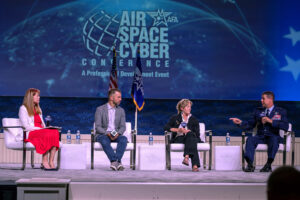
Lt. Gen. Gregory Gagnon, commander of U.S. Space Force Combat Forces, speaks during a panel at the 2026 AFA Air, Space & Cyber conference in the National Harbor, Md., Sept. 14, 2026. (U.S. Air Force photo by Airman 1st Class Ethan Klindt)
Some of the buzziest news to come out of the conference was Air Force Secretary Troy Meink’s confirmation that the United States has deployed weapons to space. It was the first time the military acknowledged the move.
“The United States now has on-orbit space control weapons capable of defending the joint force against hostile adversary action,” Meink said.
The reason? Necessity, he said. “Is there any question in the room, by anybody, about whether or not the Chinese or Russians have been developing these sorts of weapons?” he added. “For over a decade, we’ve been talking about the fact, and we have expressed concern, that the Chinese and Russians were developing weapons for space. We need to focus on making sure we can protect ourselves operating in that environment.”
Meink also discussed plans to address rapidly increasing AI-enabled cyber threats. As examples, he pointed to one-way attack drones replacing artillery as the primary weapon in the European theater.
“The threat is changing actually faster than I thought possible when I took this job 18 months ago,” he said. AI “competes with some of the world’s top programmers, cyber operators, and hackers, and these technologies are revolutionizing the battlefield. They allow countries that would not have had the resources in the past to quickly adapt and scale their combat capabilities.”
In response, the U.S. military must increase its combat power. To do that, there are plans for adding highly autonomous systems—such as having at least 500 collective combat aircraft by 2032—and using concepts such as Open Systems Architecture to accelerate procurement from GovCon. That, he noted, “has also increased competition from industry, resulting in better choices, better prices, and more combat power.”
Opportunities for GovCon
Attendees at the 2026 AFA Air, Space & Cyber Conference got an exclusive first look at a new trailer for Jimmy, a film about the life and military service of Brig. Gen. James “Jimmy” Stewart. (U.S. Air Force photo by Tech. Sgt. Louis V. Koconis)
Many discussions at the conference centered on innovation that will help the military maintain its global edge. For example, Maj. Gen. Ty Neuman, Joint-Global Strike Operations Center commander, said that low-observability, or stealth, capabilities are foundational for future flight, and he noted that the youngest bomber on the fleet is more than 30 years old.
Others emphasized the need for the battle network and integrated command, control, and communications architectures to synthesize real-time data from space, cyber, and airborne assets into situational awareness for combat decision-making.
- Mass Modular Aircraft – The Air Force is developing these new uncrewed, multipurpose aircraft to provide long-range combat power, with plans to field 100 by 2029.
- Resilient Radar System-Ground – Space Force Lt. Gen. Gregory Gagnon announced that this new satellite constellation that can track ground targets from orbit will go into space in the next two years.
- Space Domain Awareness Services – Col. Timothy Trimailo, head of Space Force’s Commercial Space Office, said the service will soon contract with industry on technology that can track and understand the intent of objects in orbit.
- Point Defense Weapon System – Chief of Staff of the Air Force Gen. Ken Wilsbach announced this initiative to improve air base security by bringing together kinetic and non-kinetic capabilities.
To facilitate all of this, the Air Force has streamlined its acquisition processes to modernize the service and the Space Force. It has established 26 Portfolio Acquisition Executives who are responsible for accelerating delivery in certain mission areas, Meink said.
Still, there are budget concerns. A continuing resolution passed this month that will go through mid-December will fund about 90% of the Space Force program, but the remainder can’t move forward without a new spending bill, said Gen. Douglas Schiess, the new chief of space operations.
Air Force Secretary Meink reiterated the need to support investment and called on GovCon to be cost-conscious with their solutions. “Many of the weapons, components, or systems we have to buy have outrun the cost curve,” Meink said. “They perform extremely well, but the costs are growing faster than the rate of inflation. We need that to change to maintain our military advantage and economic security.”
Clearly, government contractors have lots of opportunity to help the Air Force and Space Force achieve their technology goals. We’ll be watching to see what happens at Air, Space & Cyber 2027.