
AI took center stage at the Association of the U.S. Army (AUSA) Annual Meeting and Exposition, held Oct. 12-14, 2026 in Washington, D.C. With a theme of “America’s Army: The Foundation of the Joint Force,” the event drew more than 40,000 attendees, including industry experts and service leaders. More than 750 exhibitors showcased the art of the possible.
AUSA is a nonprofit educational and professional development association serving the Army and U.S. defense supporters. This conference is the premier land power exposition and professional development forum in North America.
AI Makes Moves: Project Gatekeeper
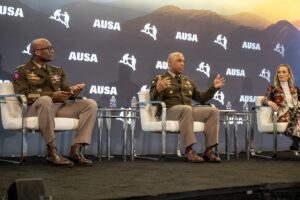
Gen. Ronald P. Clark, Commanding General, United States Army Pacific Command, speaks during the Contemporary Military Forum: Decisive Landpower—Deterrence and Partner Integration Against the Pacing Threat at AUSA 2026. Credit: DVIDS
On Oct. 23, 2026, the Army will launch Project Gatekeeper, an AI-enhanced cybersecurity sandbox for reviewing commercial software for use on Army networks. It will run on the Army’s cloud but will be separate from operational networks and sensitive data. Companies can bring their software to be assessed, even without an Army contract or program manager sponsor.
“Success, to me, looks like a company, within minutes, is able to log in, submit their code and get the green check mark from our pipeline that says you are good to go,” said Gabe Chiulli, acting Army CIO.
Brandon Pugh, the Army’s Principal Cyber Adviser, said that the service is preparing to put AI agents on its network after it awards contracts to two companies by the end of October 2026.
Although he declined to name the awardees, Pugh said that the use of AI agents “is extraordinary — something we haven’t done and we’re very excited about.” One goal of letting the agents service the network is automatic remediation of malicious activity that other tools identify.
Government contractors will have more opportunities for these kinds of efforts, Pugh promised. He touted industry for being ahead of the curve with ideas and capabilities.
New Opportunities for GovCon: Manufacturing Rodeo and Second Interceptor Competition
Acting Army Secretary Adam Telle announced another opportunity for industry next year: a “manufacturing rodeo…a race between our industrial base partners” to test the supply chain for weak spots.
“This is an early indicator that we’re acquiring a new system of seamless, frictionless symbiosis between the Army and American commercial excellence,” Telle said. “We’re going to stress test the supply chain, the manufacturing processes, and see where it breaks. We’re going to learn by doing, not by sitting around postulating at the Pentagon; we’re going to find the weak links. We’re going to make them stronger, and we’re going to keep iterating.”
In another procurement development, Lt. Gen. Frank Lozano, Portfolio Acquisition Executive for Fires, said he’s “[turning] up the heat” on the Indirect Fire Protection Capability. In the fourth quarter of 2027, government contractors will have an opportunity to compete for a contract to build a second interceptor, he said.
Lozano said the Army is open to companies that missed the first cut but kept investing in a second interceptor capability. “We’d love for you to come out to the range,” he said. The Army will provide range time and targets, giving those companies a chance to recompete and get back into the program.
Spotlight on Budgets: Uncertainty Creates Challenges
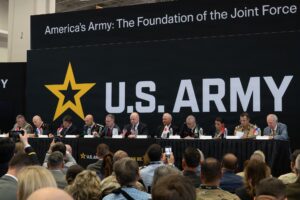
Acting Secretary of the Army Adam R. Telle, Brent Ingraham, Assistant Secretary of the Army for Acquisition, Logistics, and Technology, and international allies and partners sign an Unmanned Aircraft Systems and Counter-Unmanned Aerial Systems Statement of Intent at AUSA 2026. Credit: DVIDS
Military leaders said that the current continuing resolution is presenting a challenge for them. For instance, Gen. Ronald Clark, Commanding General of the Army’s Pacific Command, said they can’t get new capabilities for a unified network and long-range precision systems until the fiscal 2027 budget passes.
Clark said the biggest challenge is the inability to start new programs, including ones he knows will “benefit the soldier on the ground.”
The continuing resolution is also affecting the Army’s ability to keep a new spy plane program flying smoothly. Andrew Evans, Director of the Strategy & Transformation Office at the Army’s Deputy Chief of Staff for Intelligence, said that although the program is within budget and on schedule now, “next year at this time, will I be able to say the same thing? I don’t know.”
Brent Ingraham, Assistant Secretary of the Army for Acquisition, Logistics, and Technology, added that the Army will have to see how the budget shakes out before making munitions a funding priority.
“Depending on where a budget lands, what a top line looks like, whether there’s a reconciliation or not … all those things will drive us to figure out how we ensure that we continue to give the right demand signal to industry,” Ingraham said.
That leaves us on quite the cliffhanger for AUSA 2027, and we can’t wait to see how all of this plays out.