
The annual TechNet Augusta conference welcomed thousands of military and GovCon experts to discuss “how to accelerate the delivery of innovative and interoperable systems, which are crucial for decisive action in joint operational environments.” Hosted by AFCEA International, with assistance from the U.S. Army Cyber Center of Excellence and Augusta University, the event fosters communication between the defense and commercial sectors.
Members of U.S. Army Cyber Command, the Army Cyber Center of Excellence, program executive offices, the Army Chief Information Officer, G6 offices, cyber components, and academia gathered at Georgia’s Augusta Marriott at the Convention Center from Aug. 17-20. This year’s theme was “C2/Counter C2 in Support of Army and Joint Warfighting,” and more than 300 vendors showed their latest and greatest in an exhibition hall.
Army’s AI Focus
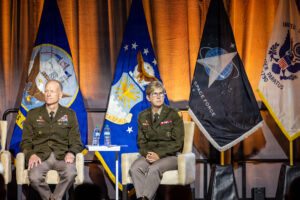
NETCOM Commanding General Maj. Gen. Jacqueline D. McPhail participated in “AI, ADOCs, and All Things Cyber,” at TechNet Augusta 2026. (Photo by Gabriel Archer)
Exactly zero attendees were surprised that artificial intelligence was a centerpiece of the conference’s discussions. In fact, AI’s momentum alongside goals of getting capabilities to warfighters as fast as possible is leading the Army “to relook at everything we’re doing,” said Army Acting Chief Information Officer Gabriele Chiulli.
Here are three areas getting special attention right now.
Agentic AI
Agentic AI is the next generation of the technology. It refers to AI that can act independently. At the conference, Lt. Gen. Christopher Eubank, commander of Army Cyber Command, explained how they’re training AI agents to work alongside humans on various tasks.
“We’ve created developers, data engineers, host analysts, exploitation analysts. You name the work role, we’re creating those,” Eubank said. “We’re training them to the same standard that humans get trained to. So, agents have a work role; they’re JQR [Job Qualification Readiness-approved]. They get trained. They get set on a mission with a human watching and deliver results.”
When the agents mess up, humans correct their course, and they retrain themselves.
AI for Cybersecurity
The U.S. Army Network Enterprise Technology Command, or NETCOM, is studying how AI can help with network security. The command currently faces 1.2 million cyberattacks on its systems each day, said Maj. Gen. Jacqueline McPhail, NETCOM’s commanding general.
“When we talk about data, we provide that highway that the data traverses,” McPhail said. “We secure, operate, and defend that highway, and it is very interesting as we look at AI and how we can leverage AI to do that at the speed of need and at the speed of our adversaries that are trying to attack both the data and the network.”
To properly test AI, NETCOM needs a digital twin. It could provide a realistic training ground without putting the network at risk. “If we can get a digital twin of the DoDIN-A, that [would enable] us to be able to leverage AI in that model to understand our vulnerabilities, where our gaps are, [and] where we do have resilience,” she said, referring to the Department of Defense Information Network – Army, the globally interconnected set of information systems, networks, software, and services that the Army uses.
AI-Enabled Workforce Readiness
The Office of the Department of War Chief Information Officer released recently a Curriculum Alignment Tool that uses AI to analyze courses, training programs, and personnel certifications. It can pinpoint which align with certain roles according to the department’s Cyber Workforce Framework.
That can promote workforce readiness and cut the time it takes to complete assignments, said Matthew Isnor, division chief of cyber workforce development at the office.
“Basically, it’s going to take that three-to-four-month process and get it down to a couple of weeks,” Isnor said, adding that historically, the work has been done using Microsoft Excel.
GovCon, Military Partnerships
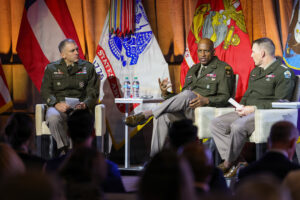
Lt. Gen. Christopher Eubank, commander of U.S. Army Cyber Command, joined Lt. Gen. Jeth Rey, the Army’s chief information officer/G-6, for a discussion focused on the Army’s evolving approach to artificial intelligence, network defense, and human-machine teaming. (Photo by Staff Sgt. DeMarco Wills)
Thanks to successful relationships between government contractors and the Army, the service plans to expand the Next Generation Command and Control (NGC2) ecosystem to I Corps later this year, said Joseph Welch, portfolio acquisition executive for C2 and Counter C2 and the executive director for Transformation and Training Command.
NGC2 is designed to unify fragmented battlefield systems, eliminate data silos, and speed decision-making using commercial tech, AI, and open architectures.
Welch praised industry for their role in providing tools for NGC2, which has 45 apps. More than 60 vendors are working on the platform. That synergy is what Welch said he is most excited about. “That’s what’s going to enable us to replace technologies that no longer work and rapidly introduce new and better solutions on a continuous path,” he said.
Looking forward, Defense Information Systems Agency Director Lt. Gen. Paul Stanton said industry and government officials alike must understand that automation and agentic capabilities are crucial to enabling the military to operate at the speed and scale necessary for future success. The key ingredient for making that happen? Standardization.
“When, not if, the enemy unleashes agentic capabilities against our operating environment, we do not have time to fight through network congestion because [we may not] know how to normalize data or network congestion because I didn’t standardize the architecture,” Stanton said.
The speed at which technology keeps changing and becoming more valuable has us already holding our breath to see what comes out of TechNet Augusta 2027.