
Policymakers, senior military leaders, program managers, and GovCon executives gathered to discuss all things next-gen at the 61st annual Sea-Air-Space Exposition. Happening April 19-22 at the Gaylord National Resort & Convention Center in National Harbor, Maryland, it’s the country’s premier maritime expo, attracting defense contractors and military decision-makers. It’s hosted by the Navy League of the United States, which was founded in 1902 and is a nonprofit civilian, educational, and advocacy organization that supports the Navy, Marine Corps, Coast Guard, and U.S.-flag Merchant Marine. More than 380 exhibitors also turned out to demonstrate their latest solutions.
Hit the Gas on Warships
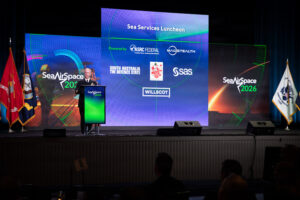
Chief of Naval Operations Adm. Daryl Caudle joined global maritime leaders at Sea-Air-Space 2026 to deliver a keynote address at the Sea Services Luncheon. (Credit: DVIDS / U.S. Navy photo by Senior Chief Mass Communication Specialist Elliott Fabrizio)
Shipbuilders got a clear message from Russ Vought, Director of the Office of Management and Budget: “If we cannot get the ships we need from traditional sources at cost and on time, we will get them from other shipyards.”
He took the industrial base to task for what he said were yearslong delays in shipbuilding programs. “Backlogs are leading to a fleetwide operational death spiral,” Vought said. “Long backlogs are to us, within OMB, key indicators of corporate underperformance.”
Not only do they leave the services in the lurch, but they tack on costs, he added, because the companies seek additional capital investments from the government to modernize their yards.
Part of the concern stems from 19 warships the Navy requested in the fiscal 2027 budget that industry has failed to produce. In total, the Defense Department is asking Congress to dedicate almost $66 billion to shipbuilding — namely 18 battle force vessels and 17 auxiliary ships that would make up the Golden Fleet that President Trump announced in December 2025.
Now former Navy Secretary John Phelan, said that the service was looking into contract changes that would allow foreign partners to fill warship needs.
“One of the things we are going to do in our contracting is if you beat schedule, you’re going to get a bonus, but you’re going to share it with the workers,” Phelan said.
Need for Uncrewed Systems Grows
Meanwhile, Navy leaders are adding a variety of uncrewed systems, each suited to particular maritime environments, to their priorities list. Rear Adm. Douglas Sasse, director of the Assessment Division at the Office of the Chief of Naval Operations, pointed to Ukraine’s successful use of small, inexpensive uncrewed vehicles in the “very constrained [Black] Sea,” noting that they might not work in the vast Pacific Ocean.
“We’ll continue to have large multi-mission warships, but we will add unmanned surface vessels, and we will add small service combatants, so that lead commanders have more options,” added Rear Adm. Derek Trinque, Director of the Surface warfare Division on the CNO’s staff. That will lead to a shift in how the service procures vessels from established GovCon leaders and new companies alike, he said.
“As a marketplace opens for medium USVs, [we] can accept bids [from] and actually award contracts to multiple partners, as long as all of their offerings can do what we need to do,” Trinque said. “What that does for the United States is help us improve our industrial base and expand our industrial base laterally, so that we have more partners across the country.”
Rear Adm. Joseph Hornbuckle, Program Executive Officer for Tactical Aircraft Programs, also touted uncrewed capabilities, especially those that support maintenance in the field. Recent conflicts that the United States has engaged in have demonstrated their importance, he said.
“All of our program offices are conducting reliability control boards,” Hornbuckle told attendees. “There is a venue that looks specifically at our top degraders. It is both government and industry, so if you are a stakeholder or a supplier and you’re not engaged in those forums, please get engaged.”
Rear Adm. Anthony Rossi, PEO for Unmanned Aviation and Strike Weapons, said one way to get contractors and military buyers on the same page is to work together “to make sure we really understand the technology we’re going after” to get quality proposals that can be approved faster.
Funding Promises Big Changes for Marine Corps, Coast Guard
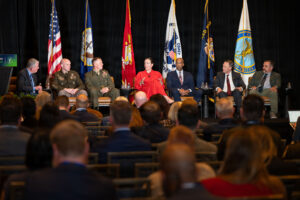
On April 21, Chief of Naval Research Dr. Rachel Riley (center) and Vice Chief of Naval Research Brig. Gen. Dustin J. Byrum (third from left) participated in a Sea-Air-Space 2026 panel titled “From Concept to Capability: Aligning Autonomy Across our Maritime Forces.” The panel explored how autonomous systems are redefining maritime operations. (Credit: DVIDS / U.S. Navy photo by Michael Walls)
The Marine Corps and Navy are working together on Amphibious Ready Groups and Marine Expeditionary Units, or ARG/MEUs. The Marine Corps’ current fleet of 31 amphibious ships falls short of what the service needs, Commandant Gen. Eric Smith said.
He praised the proposed fiscal 2027 budget for investing in amphibious shipping and in modernization the Marine Corps needs to evolve “with the changing character of war.” Smith called the proposal a “welcome down payment,” but added that “to build the amphibious fleet that our nation needs and deserves will require continued commitment of leaders in uniform and support of our leaders in government.”
The Coast Guard, too, supports the 2027 budget request of $15.6 billion. Part of that would go to robotic platforms and uncrewed systems specialties, including integrating uncrewed systems and counter-drone technologies.
Meanwhile, the service experienced a funding windfall from the One Big Beautiful Bill Act, which included $25 billion for the service to support “one of the most significant transformations in the last century for our service,” Adm. Kevin Lunday said.
With so much up in the air — and on the sea — we are excited to see how these play out and what gets top billing at Sea-Air-Space 2027!