
The Association of the U.S. Army’s 2026 Global Force Symposium & Exposition took over the Von Braun Center in Huntsville, Alabama, on March 24-26 to discuss “Delivering Victory: Leveraging the Army’s Industrial Might.” The event is the premier conference for advancing the Total Army’s modernization and exploring how the Army plans to remain agile, adaptive, and lethal amid today’s challenges.
Happening while the United States is at war with Iran, the event spotlighted the service’s Transformation in Contact initiative, which prioritizes iterative, outcomes-focused modernization. This year, the conference drew more than 7,000 attendees to its 50-plus sessions and 200 exhibits. Those attendees included Army leaders, program managers, acquisition pros, GovCon executives, and academic experts.
Acquire Things — And Quickly
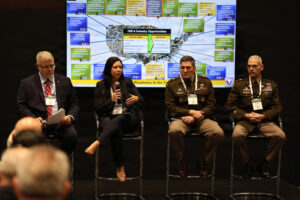
Panel discusses strategies to transform the Army’s Organic Industrial Base into a more agile, resilient, and responsive force multiplier. Credit: DVIDS
The Army is relying heavily on the GovCon industry to keep up with technological developments, said Lt. Gen. Chris Mohan, commanding general of U.S. Army Materiel Command. And with warfighters currently deployed in the Middle East, the Army’s work with the defense industry is an “essential partnership,” he added.
He pointed to what he called the aggressive integration of data and analytics into Army operations as a main initiative. From it came Weapons System 360, which gives officials a real-time look at the Army’s supply chain. The service continues to improve on that. For instance, it recently integrated it with the Maven Smart System, which uses AI for targeting and logistics operations.
“Bring us those innovative technologies and innovative ideas,” Mohan said. “I’ve never seen in my time in the Army — close to 37 years — a willingness to change at every echelon, and our soldiers, they demand it, so help us get there. Together we can drive the innovation that will enhance readiness and secure our nation’s future.”
In a similar vein, the Army’s six new portfolio acquisition executives (PAEs) discussed their goals for speeding acquisition. The service recently restructured 12 program executive offices into these six PAEs. Each is in charge of one of the Army’s capability areas, including fires, maneuver ground, command and control, counter-command and control, and others.
Halving the number of offices makes it easier to coordinate and resolve efforts, said Joseph Welch, PAE for command and control and counter-command and control, and executive director of U.S. Army Transformation and Training Command (T2COM).
“Acquisition is a team sport,” said Maj. Gen. John Reim, PAE for agile sustainment and ammunition, and commanding general of New Jersey’s Picatinny Arsenal.
Streamlining Procurement
For the first time since World War II, the entire U.S. Army “assembly line” is happening under one command: T2COM
Gen. David Hodne, T2COM’s commanding general, said the command’s mission is to help the Army adapt to the fast-shifting demands of war today. T2COM will “innovate with urgency,” Hodne said. “Our challenge is to transform our Army at speed and at scale to yield land power, a United States Army that can gain initiative for the entire joint force.”
To meet this mission, T2COM has partnered with the Assistant Secretary of the Army for Acquisition, Logistics, and Technology; U.S. Army Materiel Command; and the Army Staff, Hodne commented.
“When we anchor in the past or try to replicate past approaches buttressed by new technology, this constitutes change,” Hodne added. “Change alone is insufficient. For today’s environment, transformation fundamentally alters our approach to solving problems. Instead of doing old things differently, we must do entirely new things.”
An example of doing things differently was announced during AUSA Global Force, when the Army launched its uncrewed aerial systems marketplace, a tool that lets warfighters, allied nations, and other government agencies buy drones with the click of a mouse.
GovCon vendors with drones to sell can respond to a commercial solutions opening in the marketplace, which Amazon Web Services and the Army Enterprise Cloud Management Agency developed. That connects them to the marketplace, where they can list their product. Once the Army approves it, buyers can start making purchases.
“Traditionally, it takes a long time to fill a requirement, and we have this protracted competition, and maybe you only choose one or two,” said Col. Danielle Medaglia, head of the Army’s project management office for UAS. “Now, it’s you tell us when you’re ready. We’re going to tell you what the soldiers want.”
When Less Really is More
There’s still plenty of time before the new fiscal year starts Oct. 1, but Army officials are already planning for the next U.S. defense budget. Army Undersecretary Michael Obadal said that the fiscal 2027 budget will consolidate lines for the service’s command and control programs.
“This allows program executives the ability to shift from stagnant or obsolete efforts to emerging needs and compelling industry solutions,” Obadal said. “In close coordination with Congress, we plan to expand this into the Army C2 portfolio, allowing the rapid movement of resources to support needs and opportunities in the application, data, network, and transport layers.”
He hopes for more consolidation going forward to equip warfighters faster and at scale.
And we hope to see how all of these acquisitions and adjustments play out between now and the 2027 AUSA Global Force!