
WEST 2026, the premier naval conference and expo on the West Coast, met February 10-12 at the San Diego Convention Center to discuss all things related to this year’s theme: “Sustaining Maritime Dominance: Warfighting Readiness for the Future Fight.”
Cosponsored by AFCEA International and the U.S. Naval Institute, the event typically draws about 8,000 attendees, connecting government contractors with leaders from the sea services (Navy, Marine Corps, and Coast Guard) plus industry and academic experts. It also welcomed hundreds of industry presenters to the exhibition floor, which, for the first time this year, covered two levels.
Fuse Integration was one of the GovCon experts there to conduct a live-flight tactical networking demo.
“It was an awesome day getting our team together and flying a live demo during AFCEA to demonstrate the TENTaCLE architecture from our O-2A. This is my favorite AFCEA show ever,” said Sumner Lee, CEO of Fuse.
Modernization is Job No. 1
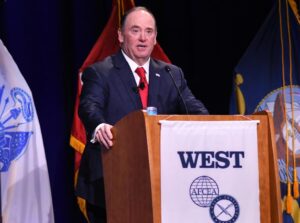
John Phelan, Secretary of the Navy, delivers keynote address. Credit: AFCEA/Karras Photography
Modernizing — and fast — was a common refrain throughout the conference’s presentations.
For the Navy, one initiative is the Golden Fleet, which gives speed and scale first billing. President Trump announced plans for the fleet in December 2025, calling for a new class of battleships that would be the most powerful yet.
“The Golden Fleet is America’s shipbuilding renaissance, restoring American industrial power, integrating unmanned and AI-enabled systems, and partnering with the private sector to deliver capability at the speed of relevance,” said Secretary of the Navy John Phelan.
He also pointed to the new Portfolio Acquisition Executive for Robotic and Autonomous Systems (RAS). It consolidates the development and purchasing of autonomous systems and is responsible for about $19 billion in acquisitions.
“Unmanned systems add mass, optionality, and unpredictability,” Phelan added. “RAS allows us to harness the ingenuity of a much broader industrial base and to do it faster than traditional acquisition pathways ever allowed.”
Chief of Naval Operations Adm. Daryl Caudle highlighted another Navy initiative: the Optimized Fleet Response Plan, a 36-month blueprint for carriers and service ships that would speed readiness time from 40-plus months to seven.
Delays during modernization are often to blame for the lag, Caudle said. “There’s just way too much whole-structure fabrication work that goes into these modernizations,” he emphasized, noting that he has asked the Assistant Secretary and Principal Military Deputy Assistant Secretary of the Navy for research, development, and acquisition to “try to tighten up how we do modernization” to address the problem.
The Marines are also modernizing. Upgrades to the Marine Air-Ground Task Force, which oversees all missions, are improving air domain awareness and counter-air tech, especially in air domain awareness and counter-air tech, said Lt. Gen. Roger Turner, commander of the III Marine Expeditionary Force.
One area of focus at the Coast Guard is taking aim at software by establishing a Software Yard (a combo of “software” and “shipyard”).
“Right now, we do software very horizontally, which doesn’t really lend itself very well to value steam management,” said Cmdr. Jonathan White, branch chief of cloud and data at the service. He noted several lines of effort, including a focus on DevSecOps, seamless AI integration, and more application programming interfaces.
“The tone and message was clear this week, the United States is leading and growing like we have not seen in a long time,” White wrote on LinkedIn after the conference. “We need to accelerate the pace while stressing every aspect of our might in order to continue asserting maritime dominance around the world.”
AI Drives Change
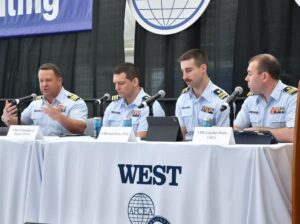
U.S. Coast Guard panelists speak at WEST 2026. Credit: AFCEA/Karras Photography
No modernization discussion is complete without references to AI, so it’s no surprise that the tech is on the minds of the Navy’s leaders. For instance, the service is currently implementing GenAI.mil, a platform the Department of War rolled out in December 2025 to provide AI tools to the military workforce.
“AI is impacting … the speed of our ability to learn from data,” said Stuart Wagner, the Department of the Navy’s chief digital and AI officer. “It’s going to change the character of war. It’s definitely going to change administrative tasks, but I think it’s going to be employed in the same way during war, and it’s going to expedite the ability to deliver data-driven effects with warfighting capability.”
He said that the military could learn from the way industry uses AI. He listed five ways AI’s ability to adjust to changes using real-time could help: system updates, re-evaluating how the system is used, changing operational planning, training and exercises, and creating new capabilities.
“We’re not trying to develop a solution and then find the problem,” Maj. Christopher Clark, head of AI for the Marine Corps, said of the technology. “We’re finding what the problem is and then applying a solution to it.”
One thing is for sure, said Marine Corps Maj. Christopher Teska, a doctoral student at the Naval Postgraduate School: AI will affect all warfighting functions. “On a weekly basis, a new model comes out that has a new capability,” Teska said. Language-related tools can bolster command and control, while others apply to logistics and predictive maintenance. “Every single warfighting function you know will be different a year from now and two years from now.”
A lot of change is afoot, and we will be watching to see how it all plays out ahead of WEST 2027!